The Fate of Pragmatism in India:
Dewey, Ambedkar, and the Democratic Ideal
By Scott Stroud (University of Texas at Austin)
Wednesday, 25 March 2026 at 8:00 AM Central Time USA (18:30 India, 21:00 China)
Abstract
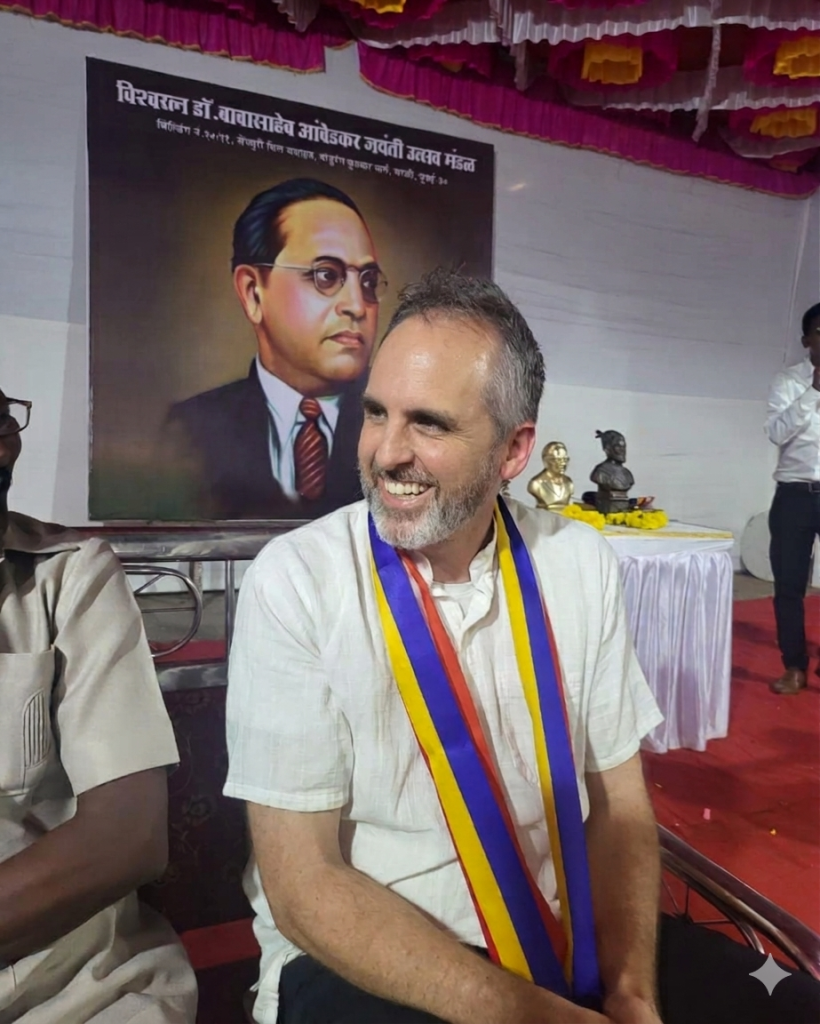
Pragmatism’s international evolution is well known. It reached beyond the American context into Italy, England, Japan, and China. But is there a story of pragmatism in India? The story of pragmatism in China often starts with Hu Shih; a little-known fact to this story is the young man sitting next to Hu in Dewey’s 1915-1916 political philosophy course at Columbia University was the person who would bring pragmatism to India: Bhimrao Ambedkar.
As an “untouchable,” Ambedkar felt the weight of centuries of oppression on his shoulders. But he also saw the value in education and eventually, the new philosophy being propounded by Dewey while they shared the campus at Columbia. He was India’s leading civil rights activist, as well as a major figure in the drafting of India’s democratic constitution in the 1940s. But he was also a theorist, a philosopher, and a pragmatist. This talk will chart the engagement of Ambedkar with Dewey’s pragmatism and show how this gives us a new entry into the global story of pragmatism—navayana pragmatism. Beyond historical matters, we shall see that Ambedkar’s pragmatist philosophy reconstructed the nature of social democracy as a moral ideal to reveal something about the propensities of pragmatism’s moral theories.
Short Bio
Dr. Scott R. Stroud is a Professor of Communication Studies and Program Director for Media Ethics at the Center for Media Engagement at the University of Texas at Austin. He writes on various topics in ethics, rhetoric, and philosophy. He is the author of John Dewey and the Artful Life and Kant and the Promise of Rhetoric. Stroud is the co-founder of the first “Center for John Dewey Studies” in India at Savitribai Phule Pune University. His most recent book is The Evolution of Pragmatism in India: Ambedkar, Dewey, and the Rhetoric of Reconstruction (University of Chicago Press), which was also published as The Evolution of Pragmatism in India: An Intellectual Biography of B.R. Ambedkar by HarperCollins India. He’s currently at work on his next book focusing on Ambedkar as a democratic theorist for our divided times.
Deriving Pragmatic Benefit from Ancient Asian Texts
By Shad Gilbert (University of Helsinki)
Wednesday, 25 February 2026 at 16:45 Kathmandu, Nepal (19:00 Beijing, 20:00 Tokyo)
Abstract
This talk applies a new tool for Global Philosophy that I call Cosmopolitan Pragmatism to a pair of Buddhist texts. Cosmopolitan Pragmatism builds on the early Conceptualistic Pragmatism of C. I. Lewis to perform transparadigmatic reconception, i.e. the amelioration of contemporary concepts by means of foreign thought. The Buddhist texts to be leveraged are the Mahāyāna Buddhist Perfection of Wisdom in 8,000 Lines (Aṣṭasāhasrikā Prajñāpāramitā Sūtram) and the Chinese Buddhist Things Do Not Shift (物不遷論), and the concepts to be reconceived are THREAT and PERMANENCE. Further consideration will be given to the prospects for Pragmatic Conceptual Engineering and reperception through reconception, which refers to intentionally altering what is conceived in order to change what is perceived.
The Philosophy of C. I. Lewis:
Lewis, C. I. “A Pragmatic Conception of the A Priori.” Journal of Philosophy 20, no. 7 (1923): 169-177.
Conceptual Engineering:
Isaac, M. G., et al. “Conceptual Engineering: A Road Map to Practice.” Philosophy Compass 17 (2022): 1-15.
Thomasson, Amie L. “A Pragmatic Method for Normative Conceptual Work” in Conceptual Engineering and Conceptual Ethics, ed. by Alexis Burgess et al. Oxford: OUP, 2020.
English Translations of Source Texts:
Conze, Edward (trans.). The Perfection of Wisdom in Eight Thousand Lines & Its Verse Summary. Bolinas, CA: Four Seasons Foundation, 1973.
Felbur, Rafal (trans.). “Things Do Not Shift” in Three Short Treatises by Vasubandhu, Sengzhao, and Zongmi. BDK, 2018.
Short Bio
Having spent 15 years in various Asian countries, Shad is pioneering a pragmatist approach to premodern Asian literature as a doctoral researcher under pragmatist scholar Sami Pihlström at the University of Helsinki. Merging the conceptual pragmatism of C. I. Lewis with modern work in conceptual engineering, he argues for prescriptive projects in conceptual optimization, especially drawing upon Sanskrit and Chinese texts from the first few centuries of the first millennium.